Showing posts with label Scotland. Show all posts

Tuesday, 16 August 2016

Arbroath January 1972

                Arbroath January 1972 . I was living in the house at 9 East Grimsby. My Dad had died the previous year and I was still struggling with it.  But I had a few things going for me: music, a camera and my books. It wasn’t a lot … Continue reading Arbroath January 1972

The post Arbroath January 1972 appeared first on Rod Fleming's World.

Monday, 18 July 2016

Scotland August 2010 with Charis

In August 2010 Charis and I went on a road trip up the West Coast of Scotland. As usual it pished with rain but the gale-force winds at least kept the midges at bay! Rod Fleming on Google+

The post Scotland August 2010 with Charis appeared first on Rod Fleming's World.

Sunday, 1 May 2016

The Genie of Aspiration

genie-of-independenceThe thing about aspiration is that it’s a tough genie to get back into its bottle.

This must be the conclusion of any mythical, dispassionate, possibly extra-terrestrial viewer when examining the current state of political affairs in the disUnited Kingdom. Less than two years ago a referendum was held which was explicitly intended to slay the nationalist monster for once and for all — sentiments reflecting those of the spectacularly unforesightful George Robertson when this whole journey began and his party found itself obliged to offer Scots a parliament of their own. Yet the genie is far from banished and if anything is more bumptious than ever.

The ‘wee pretendy parliament’ just growed and growed and now its roars — if still distant and ill-understood — have begun to frighten the gentle people of the far south, the colonial overlords of the disUnited Kingdom. Yes, frighten: for the first time since Churchill sent tanks and troops to quell the people of Glasgow, the English establishment has been rattled by events in Scotland.

For them the Scots’ discontentment is a profound mystery, one which they will probably never grasp. For the southern English, the Union is indeed a great thing. It achieved most that it was intended to. It established a militarily secure platform upon which the British Project — to make the world England — could be built and for centuries that project was a success; the Anglo-Saxon patriarchy was spread across the globe by it, taking, somewhat unfortunately, all the prejudice and insecurity of the English middle class with it.

Then again, for the southern English — and not a few Scots who have joined them — London and the south-east of England is the finest place in the world to live. It is a land of fabulous opportunity where all one has to do is work hard and one’s personal streets will be paved with gold. And they are not mean with their largesse: why anyone, from whatever uncultivated backwater of the disUnited Kingdom, may move to London and there spend their days serving the Great British Project, to the betterment — so their apologists attest — of all. Why, look at the money these people can send back to their poor relatives still living in frightful places like Inverurie or Campbeltown.

And this arrangement ideally suits the southern English who are approaching the end of their working days. London’s economic primacy over the disUnited Kingdom means that they can sell their ridiculously overpriced two-bedroom maisonettes and with the money thus liberated, buy a manor in Dunkeld or Aberfeldy. After all, the poor indigenes of these places have not the resources to compete. And if they should complain, then they must come to London, where they may, after a lifetime of slavery to the British Project,  earn enough to buy homes for themselves in the places they were born and raised. That is the free market. Yes, the system is equitable and works for the benefit of all.

Look you, the English even build roads and railways so that the impoverished Scots can travel south to where they should be, and there serve the British Project. How could anyone complain or deny this generosity?

Scotland is useful though; it gives the southern English a place to put their nuclear weapons. In truth these will never be used and represent an extravagance of obscene proportions, as well as being illegal. But they are the Imperial sabre that allows the English to pretend that ‘Britain’ is still a world player and that Vladimir Putin really gives a monkey’s what the Great British Prime Minister thinks. Once it was Nelson’s navy, now it is a fleet of submarines equipped with the most horrific killing systems the patriarchy has ever invented. Plus ca change…And in return, taxpayers (who are, of course, all English, since the Scots are all feckless spongers) even give poor Scottish peasant farmers actual real money to work on these obscenities. The fact that if anything ever goes wrong, those peasants will become irradiated flying mince, along with most of the rest of the Scots, is neither here nor there; it is not as if it were London, after all.

Meanwhile, the British Home Office decides who may enter the disUnited Kingdom, in order to protect the interests of everyone in it…or at least, the interests of the south-east of England. But then, the Scots clearly have not the competence to make such decisions: they weren’t born in England, poor things. And since the whole point of the British Project is to make everywhere England, then this too is reasonable and logical.

This is what our space-alien visitors might think, reading the crop of English and Unionist media in the run-up to the Scottish election next month. The Scots are a miserable, ungrateful shower who should be glad of the crumbs of English largesse that drop into the squalid, sordid swamp they live in. England’s generosity and magnanimity towards this backward, miserable wasteland to the north is unsurpassed and ongoing. How dare the Scots protest it?

But then our aliens, being scientists, as they must be to have got this far, would have to take another sample. They would come to Scotland and there they would hear a very different story.

The Scots do not, in the main, want an opportunity to compete for stratospheric wealth. They just want a comfortable life, thank you. The Scots do not hanker for the fair vistas of Tottenham or Islington; they prefer their own cities. The South Downs pale when compared to the Lairig Ghru and beaches? Who would choose Brighton over the magnificent strands of Scotland?

Scots do not appreciate that their children are priced out of living where they grew up and they certainly do not accept that it should be necessary for a person, well qualified and prepared to work hard, to have to go to another country in order to find a decent job.

The Scots, in the main, do not seek to pretend that they can dominate world affairs; by and large they would be happy to play a constructive role in Europe –although their ability to do so must, of course, be decided by the English. They do not respond warmly to the rattle of imperial sabres, partly because those sabres have been used, all too often, on the Scots themselves; but also because they do not covet militaristic glory.

Scots abhor injustice, discrimination and the kind of divide between rich and poor that apparently delights the hearts of their southern neighbours (and, at least till now, masters.) They are intrinsically an egalitarian lot, contemptuous of airs and graces and mocking of hereditary – or otherwise – titles. One of the greatest compliments a Scot can pay is that a person is ‘unassuming’. Their reaction to inequality is to try to make the system more fair and distribute wealth more equitably, rather than blame those trapped in poverty by it.

For a marriage to work, both partners must share a great deal in common. That which divides them – and there is always something – must be far less than that which draws them together. In many marriages, what binds the couple is their children, usually conceived in the early days. Frequently the desire to have children is the motivation for marriage. Then they have to be brought up and this implies a commitment to do so. It is no surprise that so many marriages come to an end – often amicably – when that responsibility is discharged. There is not enough in common left to make up for the differences and people do change over the years.

For the disUnited Kingdom, what bound the unlikely and disparate partners together was not children, but the British Project – making the world England, by force. For centuries this was a success and on it was built the empire upon which, famously, ‘the sun never set’.

Well that sun did, in the end, set. There is no British Empire now. It is defunct and while the world still suffers the consequences of its imposition, the disUnited Kingdom has little power to influence the global future. The British Project has run its course. It is the subject of academics and historians. Britain remains economically important but militarily it is spent. Even the operation that wrested the Falklands back from an invader, only thirty years ago, could not now be carried out by the British armed forces. The child of the disUnion, the British Project, is not only grown but has lived and died while those that begat it still sup at the same table, one of them increasingly aware of how little now brings them together and how much divides them, while the other blithely hums ‘Rule Britannia’ and fills in The Times’ crossword. ‘Eight letters, a cold place of discontent and strife…oh yes, Scotland.’

The disUnion is dead. It is defunct. It has hopped the twig, kicked the bucket, passed away, gone tits-up. It is like those marriages lived in cold sufferance of each other, where the parties stay together because it is familiar and they fear change. Our aliens, if they did not know the history behind it, would be asking themselves why on Earth two partners so completely different in so many ways would ever have come together in a union of any kind.

That is why, in the Scottish case, the aspirational nationalist genie cannot be put back into the bottle. It is an idea whose time has come. It will not go away and in the end, Scotland will be independent, one way or another. It is really up to the English, now and alongside their Unionist stooges in Scotland, to decide how much ill-feeling they wish to leave behind once the inevitable parting of the ways arrives.


The post The Genie of Aspiration appeared first on Rod Fleming's World.

Sunday, 31 May 2015

Labour’s Zombie Blues

Zombie BluesThe last few weeks have been intensely busy for me, with four books to be finished by a deadline of the 30th May. This has restricted my time for other things, notably this blog.

Anyway, in that time, much has happened. The UK General Election has come and gone and left a surprising, polarising and challenging result. Labour, at the UK level, now looks in as parlous a state as it was in the 1980, when it had become ‘unelectable’. This is despite a radical lurch to the political right. We must now ask whether this lurch actually won Tony Blair his historic majority or whether in fact voters in England were just so fed up with Tory corruption, greed and downright nastiness that they could stand it no longer.

Left to their own devices for long enough, the Tories will always cover themselves in merde; the problem is that even though they were up in the smelly stuff to their armpits, today there’s no credible alternative in England.

The Liberals, bless them, finally managed to weasel their way practically out of existence by maintaining the Tories in government. Their so called ‘limitation’ of Tory excesses was not enough for their left-leaning vote to forgive them for this, nor were they right-wing enough to curry favour with the Middle-Englanders.

In Scotland, something very different happened, but there are parallels. Here, the Tory party, at least in General Election terms, was already an irrelevancy. The Liberals’ dance of death with Cameron’s True Blues did for them in Scotland just as it did in England, and now they are left with but one Member…who is himself under threat because he lied in order to further his own ends during the run-up to the vote. He may hang on to his stipend and lavish expenses yet, but Alistair Carmichael is now revealed to be what we always said he was – a bumbling idiot, and a dishonest one at that.

But all of this was as nothing to the wailing and gnashing of teeth amongst Labour’s Scottish branch that the election result provoked. Labour too, reduced to one seat in Scotland. Who would ever have thunk it? In an earlier blog I was optimistic that the SNP might take 40 seats of Scotland’s 59; in fact they took 56. It’s as near a granny as we could wish for.

What is fascinating is that Labour in Scotland, despite this trouncing, appear not to know what went wrong. The departing (albeit slowly and disgracefully) branch manager, Jim Murphy, has all sorts of ideas about how this policy or that might have saved the day, how disputes with Union bosses cost votes, and I don’t know all what. But nobody’s listening.

There are still Labour bloggers out there claiming that the Scottish electorate is suffering from some sort of mass delusion as if they’d been burning tons of confiscated wacky baccy down Argyle Street. Nonsense. The Scots took a very calm and measured decision to terminate ‘Scottish’ Labour’s London-controlled collective ass.

Partly this was a response to the SNP’s excellent record in government, which has much reassured voters. Partly this was down to Nicola Sturgeon, who has emerged as the brightest star not just in UK politics, but arguably in Europe. That she is a woman just makes it all the sweeter – and in no small measure will soften Scottish women’s traditional reluctance to heed her party’s message.

However, the greatest factor in Labour’s defenestration was one which they brought upon themselves. They could have avoided it.

In the run-up to the 2014 Independence Referendum, the Unionists had a problem. To present the case for retaining the Union, the unionist parties then in power should have taken the lead. That would have meant the Tories. The Tories are utterly toxic in Scotland, especially the London ones, and that approach would almost certainly have guaranteed a huge ‘Yes’ majority in the Independence poll.

So the Labour Party was persuaded to orchestrate the ‘No’ campaign instead. This was puzzling at best since it had been Labour policy to promote ‘devo max’ – an unquantified increase in powers for the Scottish Parliament. But the Tories refused to allow this option on the ballot, preferring to go for an outright kill. They thought that the likely outcome of a three-way questionnaire – independence, devo max or status quo – would have likely been a split but with a majority against the status quo. This they rightly saw as a route to more constitutional problems.

Instead they wanted a simple yes/no ballot in the hope that the ‘no’ vote would be so overwhelming that nationalism would be forever silenced. They hoped to sequester those in favour of devo max into the ranks of ‘no’, whereupon they could be ignored. (That was why Cameron made his infamous speech about English Votes for English Laws on the day after the referendum – he thought his wizard wheeze had actually worked.)

Now, the consequence of this is well known; Labour was the face of Tory Unionism in Scotland during the referendum campaign which, after a last-minute, panicked promise of radical new powers in the event of a ‘no’ just scraped a victory. It was by no means enough to settle the matter indefinitely.

But to do this, Labour had to present itself as the errand-person of the Tory party. Labour voters in Scotland took one look and saw red. Although many, out of party loyalty, did vote to keep the disUnion, they were totally disillusioned with the cheap political trick that had been played, blackmailing them, through their loyalty to Labour, into supporting David Cameron and the Tories.

The bullet of self-destruction that this caused hit Labour on May 7. It was wiped out in Scotland for allying itself with the Tories during the referendum.

Now had they lost ten or fifteen seats this might have been brushed off as collateral damage that could be repaired. But to lose all but one is a disaster that not even the most brain-dead of Labour trolls (I am thinking of John McTernan, but there are so many others, you know) can fail to remark.

Labour in Scotland has been well and truly hung out to dry, not by the SNP, but by the Tories. By playing their creature in Scotland, Labour committed public suicide. David Cameron must have been very pleased.

If Labour is to recover from a cataclysm such as it has suffered it must radically change, but its room for manoeuvre is limited. Labour in Scotland is just a branch of London Labour. It has no real autonomy. It can make no decisions on its own. Everything it does is done at the behest of or worse, through London. This was proven, yet again, this week, when the media discovered that Labour had been sending letters out to Scottish members who had stated, on social media, that they would not be voting Labour – well, fair enough, you might think, but the letters were sent out from party HQ in London. That’s right, folks, London telling Scots how to behave, yet again. As if we’d not seen enough lately.

It would make sense to think, and it has already been widely mooted, that Labour in Scotland’s only hope is to sever its ties with London Labour and become a separate party. The trouble is, this would actually have to be a real separation. The Scottish electorate is now the most politicised, sophisticated and media-savvy in Europe and another Unionist stitch-up they will see through in an instant – and punish Labour again.

If a real, independent, Scottish Labour Party is resurrected from the ashes of the debacle, then inevitably, it must decide its own policies. It must actually be separate. This means two things: firstly, the career path to the Westminster gravy train that it used to represent to ambitious Scots would be severely curtailed, even if UK Labour were ever to recover enough to form a government and asked Scottish Labour to join a coalition – gosh was that a pig flying past my window?

More likely, Scottish Labour would be a Scotland-only party and inevitably its policies would drift, if not towards independence, to devo-max.

This might be enough to save Labour such that it could remain the principal opposition at Holyrood. But ask yourself this: how stable would it be for the UK were Scotland to have a ruling party that was pro-independence and an opposition that was pro-devo max? Even if the Labour party were to recover, through this gambit, such that it could actually challenge the SNP in Holyrood, the same would remain true: the only voices for the status quo would be the rumps of Tories and Liberals.

There will be another referendum, that much is certain. I find it very hard to believe that the Labour Party could ever be persuaded to play the role it did in the last one, even were nothing to change in its constitution. Surely even Labour politicians are not that stupid. (Are they?)

But if Scottish Labour did reform itself as an independent organism, is it really credible that it would lead the campaign for ‘No’ as it did before? What, and sign itself out of existence, this time forever? Were London Labour to try, they’d be laughed off as more Londoners trying to tell Scotland what it should do. And the Tories trying to sell the status quo – well then, a Yes would be in the bag before we even began.

Cameron’s short-term tactics, which secured – only just – a ‘No’ vote in the referendum and, much more convincingly, a thrashing of Labour at the General Election, were bought at no small price. That price is the Union itself, for the next time the question is put to the Scots, as it will be, there will be no-one who will dare speak up for it.

In a funny, yet, with the benefit of hindsight, strangely inevitable twist, the ‘No’ vote last September almost certainly killed the disUnion dead. It may still be staggering on, but it’s a zombie. It’s just a matter of time now before it collapses. We should have a new anthem, and call it ‘Zombie Blues’.

The post Labour’s Zombie Blues appeared first on Rod Fleming's World.

Saturday, 25 April 2015

It’s Not About the Economy, Stupid

It's Not About the Economy, Stupid

See: We really do like you. Pic:Rod Fleming

The unending and apparently increasing hysteria of the London commentariat in response to the spectacular rise of the SNP in Scotland continues to dominate the UK media. It is clear that many of the pundits – many of whom, amazingly, are actually of Scottish origin – really don’t get it.

Again and again the argument devolves to ‘why do the Scots hate the English so much?’ clearly implying that the only reason Scots would not wish to be governed from 400 miles furth of their borders must be that they dislike the English. It is both a petty allegation, because it offends the basis of democracy, and plain old wrong.

When I was 17 I left home and went to London, like so many other young Scots. The story of my time there is not germane, but I was amazed by how obsessed with money the people were. It seemed to be all they ever thought about. In later life I came across the same attitude not only from Londoners but from others in the South East. ‘You have to go where the money is.’ Even more strange, to me, was that amongst the most profoundly affected by this notion were expatriate Scots (who managed to add an insufferable air of superiority into the mix; but that is also another story.)

The rise of the SNP since 2014 cannot be explained in terms that someone whose sole measure of value is monetary can readily understand. The good folks of London and the southeast, who apparently have swallowed whole the lie that the economy is ‘booming’ – we are curious as to what kind of ‘boom’ it is that can only be achieved by subsidising the richest companies in the country by £11 billion a year in order that they can underpay their workforce, but, hey. Anyway those good folks clearly cannot comprehend why the Scots would even think about getting off this (imaginary) gravy train.

So they think we must not like them.

I think we should explain things so that they might understand why their cosy little political arrangement looks about to come crashing down like a house of cards.

The first reason is constitutional.  Westminster’s famed ‘first past the post’ electoral system is specifically set up to ensure that a party achieving less than half the vote share may still command an overwhelming majority in the House of Commons. At the same time, the system is essentially bipartisan with one or other of the two ‘major’ parties enabled, by the voting system, to form a government supported by that commanding majority.

What may be less obvious is that it is also designed to favour London and the southeast, because this is the most populated part of the UK. That seems democratic enough in itself; but there is another problem.

Because of the constitutional arrangements above, the two ‘major UK parties, the Conservatives and Labour, have become totally focussed on winning over the ‘floating’ voters in London and the southeast. The Conservatives are the natural party of this region, and so Labour has, since the rise to power of Tony Blair, turned itself into a very slightly modified version of the Conservative Party. Time and again, the Labour Party has sworn to follow the Conservative economic line because its leaders believe that to stray from it will alienate those floating voters.

Nothing illustrates the catastrophic failure of the post-Thatcher era than this. Tony Blair adopted Thatcherism and called it ‘New Labour’, all in order to win those southeastern votes. This policy has led to, as we have mentioned before, a situation where there is simply no choice for voters: it’s Blue Tories or Red Tories and that’s your lot. This has disaffected the electorate such that the first past the post voting system has been compromised.

The present Tory administration was only able to govern in a coalition with the feckless ‘Liberal Democrats’ (a misnomer if ever there was one). Similar arrangements have applied before, for example in the 1970s when the ‘Lib-Lab Pact’ propped up a failing Labour Government, or, less well known, in the 1990s when the Ulster Unionists (now the DUP) held up Major’s lame duck Tory administration; however, formal coalitions are rare and happen, historically, only at times when the UK is under severe existential threat. This happened during World War Two.

Now, however, the political landscape has changed such that today, it appears that coalitions may become normal.

While the system favours the southeast and London, it is not exclusively dependent upon it. So in becoming increasingly right-wing to attract votes in London and the southeast, Labour has alienated its voters elsewhere. Labour high command believed that the tribal loyalty of its supporters outside the southeast of England would always be enough to carry it through, and as long as there was no credible left-wing alternative, they were able to do this.

In the north of England, there remains no such alternative, but in Scotland and also Wales, there is. Here too, Labour counted on historic tribal loyalty to hold up its vote, and made no changes to its overall policy when confronted with SNP gains in the Scottish elections, reckoning that the voters would always come back to Labour for the general election, since the SNP could never be one of the two big parties that are supposed to be able to form a Westminster government.

This might have continued, but for a catastrophic mistake made by Labour in the run-up to the Scottish Independence Referendum of 2014. Knowing that a Tory-led campaign would inevitably be rejected by the Scottish electorate, Labour was persuaded to be the face of Unionism in Scotland.

This meant that Labour had to present the case for Unionism on behalf of the government. But that government was identified in Scotland with the Tory Party, which is toxic there; the poison stuck to Labour. This was exacerbated by David Cameron’s crass and opportunistic attempt, immediately after the result was announced, to link the promises of further devolution which had been instrumental in achieving a rejection of Independence, for the while, to so-called EVEL – English Votes for English Laws.

Many people who had voted ‘No’ in the Referendum saw that this as a betrayal of the promises that had been made and which most observers believe secured a ‘No’majority. Doubtless Cameron had his own reasons – centred on votes in London and the southeast, as usual – but in Scotland the gesture was badly received.

This set anyone who had campaigned for the disUnion up as a target. And that target was the Labour Party.

In other parts of the UK this might not have mattered, because as we have said, there is no credible left-wing alternative to Labour. But in Scotland that is not the case. The SNP has positioned itself significantly to the left of Labour on a wide range of issues and furthermore the SNP was the party of government on Scotland. Its credibility was cast iron and bullet-proof.

The landslide which all the polls predict will virtually wipe out Labour in Scotland has two principal causes therefore; the first being the establishment of Labour as a right-wing, neo-liberal party and the second was its clear identification with the Tories during the Referendum debate.

What Labour had not recognised was that it had not taken its Scottish voters with it. During the last few weeks, many disillusioned former Labour voters have been reported as saying that ‘Labour left me, I didn’t leave it.’

This is the crux of the issue. There is a fundamental difference between the vast majority of Scots and the people of London and the southeast of England. This difference is visceral but Labour’s high command simply thought it could be swept aside. And the difference is that while for London and the southeast, it is indeed, all about the economy, in Scotland it simply is not.

Scots are not obsessed with money the way people in London and the southeast are. Those Scots who are so obsessed, move to London – and so are no longer Scottish voters. Those who remain in Scotland are interested in other things, notably quality of life, free education, good health care, fair treatment of the elderly and vulnerable, social fairness and a justice system available to anyone. These values are far more important than they are elsewhere. Scots do not, in general, seek to become filthy rich but instead, to have a nice life, in reasonable comfort, with good health care. This is exactly what ‘austerity’ is denying them.

It should have been blindingly obvious to the Labour high command that their strength in Scotland would remain only while the party was seen as being the only one that could deliver the things that Scots value. But Labour has adopted right-wing policies, in order to please the voters of the southeast of England, to the point that it simply is not a credible left-wing party any more and, worse, as far as Scotland is concerned, does not reflect Scottish values. It has become Tory Party Lite and almost as toxic in Scotland as the original version.

This landslide was just waiting to happen and it counts as the most massive own goal of any British political party in recent years; it is one that Labour high command should have been able to predict, too.

There are many reasons why the defenestration of Labour in Scotland is welcome, not least its arrogant cronyism and presumption of the right to voter support despite slavishly following Tory policies like ‘austerity’ and a replacement for Trident. It has nothing to do with Scots ‘hating the English’ and everything to do with their having completely different, and increasingly incompatible, values.

The real, underlying reason for Labour’s fall from grace is simple: as far as Scotland is concerned, it’s not about the economy, stupid. Both Scots and English people must realise that this is a profound difference and reflects two completely, and arguably increasingly, different national characters.

At the same time the changing nature of voter patterns and the likelihood of another hung Parliament means that the SNP, if it securs the share of vote that all the polls suggest it will, will hold the balance of power. Since there is no evidence whatsoever that Labour will be able to recover in Scotland — and many in the party now consider Scotland a ‘lost cause’ — then as long as the constitutional crisis brought about by having inadequate voter choice remains, the likelihood is that the SNP will continue to play a pivotal role in UK politics, althought hey could never themselves form a government. Well, so be it; the SNP is simply using a system designed by others.

The disUnion may stumble on for a few more years, but unless London and the southeast moves back from the right, it cannot survive in the long term. The differences in values between the two national characters is now linked to a failure of the first past the post system such that the larger, English component may have no choice but to heed the will of the Scottish one. For decades a right-wing England has dominated a left-wing Scotland and considered it fair and even ‘democratic’. Now that same England may be faced with a left-wing government that is held in place by Scotland’s votes.

Those in England who say this is undemocratic only reveal their misunderstanding of what the disUnion actually is and demonstrate that they do not consider it to be one nation at all; or rather, perhaps, that they see it as ‘Greater England’. They underline the intrinsic failure at the heart of the disUnion: Scotland and England are different countries.

Scots don’t hate the English; they just aren’t English themselves.

The post It’s Not About the Economy, Stupid appeared first on Rod Fleming's World.

Wednesday, 26 February 2014

Archaic Humans Discovered in Scotland

Homo-heidelbergensis Scientists all over the world are turning their attention to Scotland in the wake of a shock discovery that ‘archaic’ humans may be alive and well and living there.

The discovery came when one of them was filmed saying that they ‘were not evolved to make political decisions’.

Professor of Anthropology Farquhar Mc Farquharson of the University of Aberdeen explained: ‘All modern humans – Homo sapiens – have highly sophisticated social behaviour including the ability to arrive at complex decisions within a formal political framework. The discovery of a population that lacks this ability, apparently living alongside more developed hominids, is very exciting.’

Friday, 14 February 2014

Tryst on Februar Fowerteen – A Scots Allegory

a-tryst-tree
Pic: Rod Fleming


A fell cauld wind wis sauchin ower the muir as the bonny wumman gart her wey tae tryst her jo. For the necht wis Februar the fowerteen, an aabody kens at’s the necht for luve.

She wis winsome eneuch, tho the first blush o youth, it maun be said, was left ahent her a lang while syne. A body mecht hae speirit at himsel how comes a lass o sic natral attractions hidnae been wad this mony a lang year.

At last she reached the spot ablow an auld aik whaur she an her jo hiv met this necht mony mair years nor either of them wad care tae hink on. Her jo wis aaready there, a puckle fashit, ye mecht hink, wi the wye he wis stridin up an doon, his een flashin faniver he luikit up.

“Ah, here you are, at last,” he intoned, as the lass presented hersel.

Wednesday, 12 February 2014

The Vampire Rises : Roads to Referendum 3

vampire-rises Pic: Rod Fleming

Eight years after Scotland voted ‘Yes’ to Devolution, but had seen this victory snatched away by Westminster, things were very different.

The most hated Prime Minister in recent history – possibly all history as far as the Scots are concerned – Margaret Thatcher, had focussed minds on the fight against her all over the UK. Scottish Labour rode high on this wave of anti-Tory sentiment, and lost no time in asserting that it was the only way to be sure to get rid of the Tories. A vote, they claimed, for any other party, was a ‘vote for the Tories’.

But it was a gamble. Thatcher’s popularity in England had increased radically since she first had been elected. In England, though far less in Scotland, her resolve in fighting and defeating the Argentinean invasion of the Falkland Isles, had played well for her. She called an election in 1983 and found her majority increased.

In 1987, Thatcher called another General Election.

Thursday, 6 February 2014

The Empty Palace: Roads to Referendum 2

old-royal-high-schooloDuring the 1980s, Scotland’s political scene was polarised by a cathartic and visceral detestation of the UK Tory Prime Minister Margaret Thatcher. This, for perhaps the last time, caused a genuinely British response, in that many Scottish opponents of Conservatism, badly discouraged by the calculating and dishonest way which the Home Rule that Scots had voted for had been snatched away by a self-interested Westminster, fell back to old loyalties, and threw their weight behind the familiar Labour Party, in an effort to rid themselves of the hated Tories.

Monday, 3 February 2014

French Onion Soup! in the News

rodcourier.wee
Those avid readers who live in Scotland will be able to see yours truly’s geggy mutt plastered all over the pages of The Courier newspaper today. Support those who support me, I say, so get out and buy a copy! You can download the full page image HERE.

It’s publicising my hilarious collection of memoirs on life in France called French Onion Soup!, which you can download FOR FREE from Amazon today and tomorrow, as part of the promotion.

Please, please, though, if you like it, please leave a review on Amazon.

Tuesday, 28 January 2014

The Roads to Referendum: 1

scotland-referendum A campaigner in the 1979 Scottish Devolution Referendum

This year’s Scottish Independence Referendum is  one of the most important political events in the lives of most living Scots. It outweighs in importance, for Scotland, the fall of the Berlin Wall and the collapse of the Soviet Union. It outweighs the powerhouse rise to prominence of a rejuvenated China or an India that is on its way to being not just a regional, but a global, superpower. It is even more important, though perhaps less so, than the accession of the UK to what was then the EEC and is now the European Union. In this series of articles I am going to outline the history of the Referendum, as I saw it evolve.

The coming Referendum is the single most significant event to occur in Scotland since the end of World War Two. That event brought about the end of the Imperial era, in which European states used their military strength to dominate the planet. With Europe in ruins, and the United Kingdom pauperised, the control systems that had held empires in place collapsed. The British Empire, which Scotland had been a part of, was consigned to history.

Friday, 24 January 2014

Whither Now Scotland

saltire Pic: Rod Fleming
Whither Now Scotland:
Dateline: Friday 19 September 2014
By Rod Fleming, reporting from Calton Hill in Edinburgh, Scotland, for Rod Fleming’s World.

This morning, the whole of the United Kingdom woke up to the most important announcement in its history: the Scottish people have voted to bring it to an end.

After 307 years of often troubled partnership, in two years the partners in the unitary state will separate and become independent states, Scotland and what has been christened the ‘rUK’, the ‘rest of the United Kingdom’.

In a speech delivered, unusually, on the steps of the Scottish Parliament in Edinburgh after the poll result was announced, Scotland’s First Minister and the leader of the Scottish National Party (SNP), Alex Salmond, was statesmanlike but clearly delighted. Congratulating the Scots on their momentous decision, he called on ‘All the people of Scotland to put their differences behind them and work together for our country, our nation, and our future.’

Friday, 17 January 2014

Wot? No Rabbits? - The Brither

mr-chad-wot-no-rabbitsWot no Rabbits?

Now my brother was a bit of a character. I’m not talking about my wee brother, here, or the big one I suddenly discovered I had  in 2004 that no bugger ever told me about before (aye, we’ll get to that.) I mean my other big brother Sandy, AKA Sye.

Now Sandy did things his own way. He ran a car breaking yard—and trust me, there is no more joyous place to spend your school hols than in a place like that—and he lived in a wee cottage in Arbroath, one of those sandstone ones. Sandy’s wife was called Toos and she was Dutch.

Sandy was always coming up with schemes and one of these was inspired by Toos, who told him that people in Holland raised rabbits for the pot.

Friday, 10 January 2014

The Call of Duty?

[caption id="attachment_1241" align="alignleft" width="236"]call-of-duty Pic: Rod Fleming[/caption]

The last time I was back  in Scotland, I was asked, ‘Would you ever live here again?’ I gave a non-committal answer to avoid offence, but inside myself, I believed I knew; no, I would not.

In truth, I had not then and still have no plans to live in Scotland again. I love the country and the people, but I am both a Scot and a European; the day life in rural France gets too humdrum, it won’t be to Scotland that I turn.

In the last few months I’ve thought a lot about this, however.

Wednesday, 3 July 2013

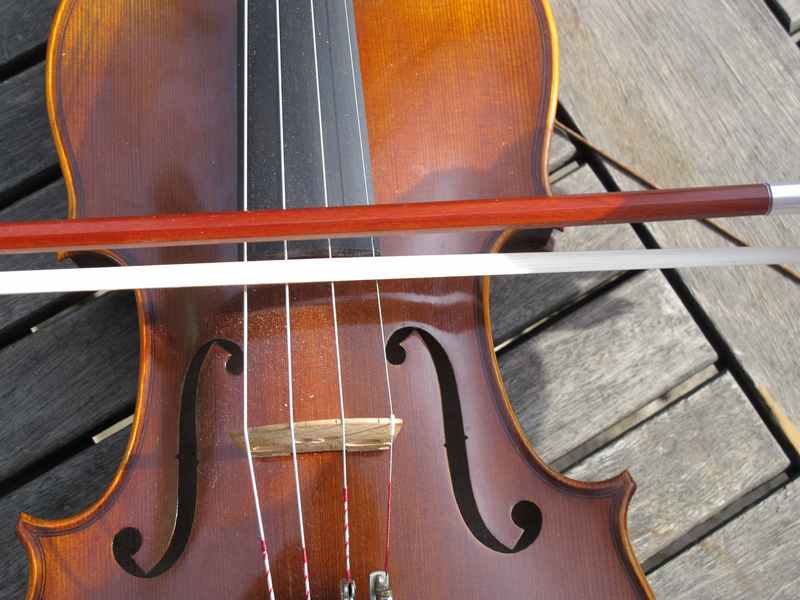
Grip: How to hold the fiddle and bow

[caption id="attachment_536" align="aligncenter" width="800"]Grip the fiddle and bow  photo Grip the fiddle and bow so that the bow crosses the strings at a right angle[/caption]

Once you have the grip of the instrument


under the chin sorted out, the next thing to address is the right hand's grip on the bow. This can cause a great deal of trouble though in my opinion is not as tricky as the left hand. Again, the secret is to avoid tension; the hand must be relaxed. To do this, all four fingers and the thumb must be in contact with the stick, and all must be curved. This is hugely important. The most common grip errors are for the little or pinkie finger to lock and become straight and rigid. Do not allow this to happen. Another is for the pinkie to lift off the stick, which is also wrong. More subtle and harder to see but just as damaging is for the thumb to become stiff.

Saturday, 22 June 2013

Poaching the River in English!


[caption id="attachment_324" align="alignleft" width="200"]Poaching the River cover Poaching the River[/caption]

 Poaching the River is back on the shelves, both physical and virtual, so I have been addressing the next issue.


 Poaching the River was written only partly in English, or at least the Scottish version of it, and all the dialogue is in authentic Mearns Doric. That is my native tongue of course, although I didn’t really know it until I was at school.


 The book was written as a homage to that culture, but it is a sad fact that there are few of us left who understand Doric, or can speak it. Ever since Poaching was first published I have had requests to translate it into English, something I have always resisted, for a number of reasons.


Wednesday, 19 June 2013

Poaching the River Back in Print and Ebook

[caption id="attachment_324" align="alignleft" width="640"]Poaching the River cover Poaching the River[/caption]

Poaching the River was my first published book. It's back in print! (and ebook!)


Buy it HERE from Amazon.co.uk


or

HERE from Amazon.com


ISBN:978-0-9554535-0-2


Poaching the River tells the story of a sleepy Scottish coastal village where the tranquility of life is literally blown up in the air.


Acclaimed as a ‘true classic’ of humorous fiction, Poaching the River opens, after introducing the heroes, Big Sye and his pal Peem, with the return of the beautiful Rae Swankie to the village of Auchpinkie in Scotland.