Showing posts with label God. Show all posts

Thursday, 7 January 2016

Syncretisation and the Jesus Myth

triple cross

triple crosses

In an oral culture — one that is not written down — mythology evolves in an organic manner as it is passed from storyteller to storyteller. The Jesus myth was created in exactly this way, pasted together from earlier sources. This process is called ‘syncretisation.’

There is no fixed record of an oral tradition, by definition. This is difficult for us to grasp sometimes because we are so used to having a written standard by which tales can be measured. In an oral culture or tradition, this is not available so instead, myths grow and develop to reflect the lived experiences and cultures of the people telling them. It was only when writing was invented that these traditions could be codified and by that time, they have been evolving for many thousands of years. This means that there are many versions of the same myth, as different peoples have carried it forward.

The result of this is that we cannot say that, because detail differences exist between two similar myths, they are different or have different origins. In fact the strong likelihood is that they are indeed the very same but have organically evolved differences through generations of storytelling. What we have to do is to look at the threads of commonality, the points of similarity. This is exactly as a biologist does when trying to identify an unknown species; in biology, the traditional method is called ‘Linnaean Taxonomy’ where we find points of reference that allow us to identify to which other species our subject is related. We do something very similar in mythology.

This is the reality of mythology and all mythologists and serious historians recognise the influence of syncretisation.

Religious apologists, especially fundamentalist Christians, are horrified by this and attempt to deny it, but it is not necessary to take their point of view seriously. Their protestations, which verge on the ridiculous, that the detail differences between the Jesus myth and earlier ones are simply a rhetorical device used to confuse the argument. These people have no interest in the truth, only in promulgating a cult belief for which there is no evidence. They represent a vested interest: religious control over society and the continuing flow of money into their own coffers.

So let’s look at the original source from which the Jesus myth was syncretised.

Writing was invented by the Sumerians, some 6500 years ago, and in the material they left there are already a number of myths that are clearly syncretised from an original common source. The best known and most complete of these are those of Inanna.

Inanna is an anthropomorphic deity, which is to say she had a human form — superhuman in fact. Previous deities were the Mother Sea, Nammu to the Sumerians and the Mother Earth, Ki. These were distant and remote and could not be communicated with directly. We call these transcendent deities; Inanna on the other hand has a human form and lives, at least partly, amongst humans.

So here we have the first obvious point of commonality between Inanna and Jesus: they are both anthropomorphic — that is, human form — iterations of a transcendent or non-human deity.

On commonality, however, is not enough to prove the relationship. When we look into the myth of Inanna, however, we find many more. The most significant of these is the story of Inanna’s descent into the Underworld, which we discuss in some detail in Why Men Made God.

In this, Inanna decides to enter the Underworld, or in other words, to die. She puts on her finest clothes and jewellery and, accompanied by a servant, goes to the Palace Ganzer, the entrance to this dread place. There she hammers on the door until it is opened.

The doorward demands to know who desires entrance and why and Inanna says she has come to visit her sister, Ereshkigal. This information is relayed to Ereshkigal who, though deeply troubled by it, commands that Inanna should be allowed to enter. However, at each of the seven gates she must pass through, an item of her clothing and jewellery is to be removed.

Inanna explains to her servant that she will enter the Underworld. The servant must wait for three days, and then seek help. She is to ask for this from three other deities but only one, Inanna’s uncle Enki, the Lord of Wisdom and Sweet Water, will help.

Inanna enters the dread Underworld and at each gate an item of finery is removed so that she is naked when she appears before Ereshkigal. Inanna then does something strange: she causes Ereshkigal to rise from her throne and sits there herself.

The Anuna, the judges, see this and judge her; they look at her ‘with the look of death’ and Inanna dies. Her body is hung on a hook on the wall to rot.

Inanna’s servant waits the prerequisite three days, lamenting and ‘lacerating her eyes and buttocks’ and then sets off for help. As Inanna has predicted, the first two deities that she visits refuse to help, saying that no-one may recover from death and that this is all Inanna’s fault; she must bear the consequences.

The third, Enki, however, is prepared to assist his niece. He takes the dirt from under his fingernails and creates two tiny spirits. He tells them to enter the Underworld in secret and go to the royal chamber where they will find Ereshkigal in agony. They are to say that they will relieve her pain if she will release Inanna. They are to ask for nothing else. Enki tells them that Ereshkigal will at first refuse and offer many other things and great riches but they are to refuse until she agrees. They are then to use two magical devices Enki gives them, the life-giving plant and the life-giving water, and to place these on Inanna and in her mouth; she will then come back to life.

The two spirits set off and find everything as Enki has predicted: Ereshkigal is writing on the floor of her chamber, her hair ‘like leeks’ and in agony. At first she refuses to release Inanna but eventually she gives up; she agrees and the spirits give the life-giving water and plant to Inanna, who is brought back to life and, in the company of the demonic guardians of the Underworld, rises up to life. However, there is a catch: Inanna may only spend 6 months of the year in the world above, and the other six months in the Underworld.

So let’s deconstruct this a bit. You recall that I said the Goddess Earth was called ‘Ki’. Ereshkigal means ‘Lady of the Goddess Earth’. In other words, she is the anthropomorphic representation of the older Goddess, the Earth.

This tale comes from the temperate zone, where the year has seasons. So, half the year is plentiful and crops will grow, and half the year they will not. Sumer even then, though not as arid as today — it lies in what is not Iraq — had a long dry season when the ground was parched. The reference to Inanna spending 6 months underground and 6 above is directly related to this.

Inanna and Ereshkigal are actually two facets of the same Goddess, the Earth, one, Inanna in her bountiful summer and the other, Ereshkigal in winter. This is why Inanna becomes Ereshkigal and sits on her throne, and then is reborn from herself. The goddess of light dies to become the goddess of darkness, and then is reborn from herself. The reference to Inanna being divested of her finery is a metaphor for the dying back of the vegetation as the year cycle progresses. Then she dies and goes under the ground — the Underworld. But next spring she will be reborn.

Ereshkigal’s agony is the suffering of giving birth, as she brings Inanna once again into life. Then Inanna goes up out of the Underworld. To the Sumerians, the living world sand heaven were the same place: deities and many other spirits inhabited the same physical space as humans, but were invisible. Inanna is ‘the Queen of Heaven’ but she lives on Earth. So when she rises from the Underworld, she is rising into Heaven, as the Sumerians understood it.

We know from the surviving mythology and the artefacts left behind that prior to the establishment of patriarchal rule in Sumer in the third millennium BCE, a matriarchy was in operation. We have clues as to how this was run from surviving, later texts and these show a slow and deliberate divestment of powers from women and the Goddess to men and gods. So we should not be surprised that a myth that originally featured a woman should have been altered to make the central character a man.

To establish a chain of syncretisation we need to find several points of commonality between the two tales and preferably other myths which also show similarities. Compare this with another famous Biblical myth, that of Noah and the Flood. This is a straight copy of the Sumerian tale of Atrahasis, with only a few names and details changed. This is not so much syncretisation as direct plagiarism. The Jesus myth is a far more subtle case.

So what are the points of commonality? Well in the first place, the main character is an anthropomorphic version of a transcendent deity. Inanna is the human form of the Earth Mother, while Jesus is the human form of the Sky father. This is a strong correlation.

Then, the core issue is that the central character dies and then is reborn. This places both the original and its derivative, the Jesus myth, into the category of ‘dying and rising deities’ stories, of which there are a very great many from all over the world. As we explained in Why Men Made God the annual regeneration of the Goddess, the Earth, was and remains central to the survival of human life in the temperate zones and these tales are expressions of this.

Both Inanna and Christ are hung on a high place for their bodies to corrupt. For Inanna this was a hook on the wall and for Jesus a stake called a ‘crucifix’. (The Romans did not kill people on crosses at this time; they invented this form of execution later to mock Christians. We shall discuss that another article.)

Then, both Inanna and Jesus physically enter the Underworld, which is a metaphor for the reality of death. For a Sumerian this was literally the earth beneath our feet so the Palace Ganzer, where Inanna dies and is reborn, is under the ground. This is because inside the Earth, under the ground in this understanding, is within the Goddess’ body, inside her womb.

In the Jesus myth, the hero’s body is placed under the ground in a tomb, which is then blocked with a stone; the tomb is a metaphor for the womb of the Goddess and both Inanna and Jesus are reborn from it.. Both characters are in the Earth, inside the womb of the Goddess where regeneration occurs for the three days that they are dead.

Why three days? This is one of the most ancient mythological references we know. It gives rise to the concept of ‘triplism’ and we find this all over the ancient world from triple goddesses to three-headed dogs like Cerberus, who guarded the gate of the Greek version of the underworld. It derives from natural observation. The moon has three phases of light, waning, full and waxing; the temperate Earth has three seasons of life, Spring, Summer and Autumn; and perhaps most crucially, at the solstices, there are three days when, even to an observer using a modern sextant, the sun appears to rise to the same height in the sky at midday. On the third day after the winder solstice it can be observed to begin to rise again: this is why Jesus mythical ‘birthday’ is the 25th, a date he shares with nearly all other agrarian deities that are derived from a solar-observing culture. The 25th is the first day that an observer can see the change in declination of the sun and so know for certain that spring will return.

(We should note here that our ancestors were not sun-worshippers. In all but one culture, the short-lived Amarna culture of Egypt, invented by the Pharaoh Akhenaten and rejected after his death, the sun, in all the cultures of the near east and Mediterranean, was associated with a minor deity. The sun was seen as being under the control of the Goddess Earth. The deity being worshipped was the Goddess but the sun was the indicator that she would regenerate. So monuments like Stonehenge are principally solar observatories and not sun-worshipping temples. They undoubteldly had a religious function, but the deity being celebrated would have been The Goddess.)

This three day hiatus, which also happens at the summer solstice, is the main reason why Inanna remains dead for three days and it is also why Jesus does. After their ritual rebirth from the womb of the Earth Mother, both deities rise into Heaven — which in the time that Inanna was invented was a plane contiguous with the one humans live on, but which, by the time Jesus was, had syncretised into being in the sky; but here again we have a wealth of material that clearly shows this evolution.

Once again, it should be noted that not one but three crosses are placed on Calvary for Jesus ‘execution’; simply another iteration of triplism and the Goddess mythology that informs the Jesus mythology.

Syncretism, just by these points, has already been established, but there are more commonalities. Inanna’s rebirth is facilitated by a woman. In Jesus’ myth, it is women who open his tomb and allow him to rise again. These women represent the cadre of priestesses who officiated and celebrated the regeneration of the Goddess in the early solstices. They are the midwives of the Goddess who, in the Jesus myth, perform the same role for the male deity.

The other useful tool to establish syncretism is the existence of similar myths from the same region which allow a mythological timeline to be established between the earliest that we know of to the latest. So do these exist? Can we establish such a timeline? The answer is an overwhelming ‘yes’. The Middle and Near East, the Levant and Eastern Mediterranean are replete with tales of this order from other Sumerian versions, such as that of the Goddess Sul, to the Eleusian Mystery cults, to the Greek tradition of Orpheus and Eurydice. In fact this meme is so common that is has its own name, katabasis. This is derived from the Greek and means ‘going downhill’ or ‘descending’ and mythologists use it to describe the huge number of such myths that exist. When we look at the Jesus myth in the context of these others, we begin to see that there is nothing at all remarkable or strange about it; it is just one of many variations on a theme.

Christian apologists have long been aware of the catastrophic threat that an understanding of syncretisation presents to their claims. If Jesus could be shown to be just another iteration of a standard ideography, then religious claims for him to be ‘unique’ would be completely torpedoed. This was understood as early as the first century CE when the Christian apologist Justin Martyr claimed that the earlier stories has been ‘planted be the devil’ to introduce doubt. Surely a mature and educated person must see the convenient disingenuousness of such a claim; and then perhaps remark that for Justin to say that was odd, while in other letters he was actually claiming that Jesus was ‘no different’ to earlier deities like Perseus. As ever, the apologist will use any ruse, no matter how preposterous, to press the claim for his (or, unfortunately, her) ridiculous claims.

The fact that Jesus is just another syncretised ‘dying and rising’ or ‘katabatic’ deity has been established beyond any question since the nineteenth century; but such is the power of religion to strip money from the deluded and channel it into the hands of charlatans that this fact — and it is one — is repeatedly denied. To believe in such things today is obviously to live in a state of ignorance and denial and one should ask oneself whose interests are best served by keeping so many people in such a state; the answer, of course, is the wealthy and the powerful. They invented the patriarchy and the religions that

The post Syncretisation and the Jesus Myth appeared first on Rod Fleming's World.

Friday, 7 August 2015

Evolution observed in trout

evolution-trout-salmo-truttaYou have to be brain-dead to deny the fact of Evolution these days. Well, these last 150 years actually… Apparently though, at least 40% of USians (other Americans are smarter), are indeed just so cerebrally demised. Hopped the neurological twig as it were. Zombified the gray matter. Deceased the thinking apparatus.

Now why would we worry? These are sister-shagging Bible belt rednecks who still think the South actually won the Civil War, aren’t they? ‘Oh no man we just kinda took a time out for a mint juleps n some grits n shit them gaddamn Yankees done called time on us!’ So who cares what they think?

Well the trouble is, they get to elect the Preseedunt of the Yewnited States (of America, not Mexico), and unfortunately, given the performance of some of the incumbents, that is the most powerful office in the world. I mean they elected Dubbya. (Well they didn’t really, but he still got the job.) And there is a risk they might elect another scion of the Terminally Religionard House of Bush next year.

‘Howdee do Jebby boy! Done shot any coons lately? I do mean raccoons now, y’all. Maybe one o them Afreecan Geeraffes? Or a Liahn?’

Mind you, I must admit that this one is less obviously an evolutionary throwback

evolution-bush-chimp

Well he does

— an irony lost on the Scions of Bush — than the last. Visually anyway. Lemme pick a louse or two there, Dub.

Maybe southern shitkickers too busy chasing their sisters’ tails to think about it might not be worried that the most powerful person in the world might be a man whose brain has already said ‘Hasta la vista’, but the rest of us should.

You could ask whatever it is now, a quarter of a million dead Iraqis, or Kurds or Syrians what they think, but oh dang woops a daisy, they done got killed already. And anyway, they ain’t Chrischuns.

But one must never lose hope of turning the tide of wilful, self inflicted, deliberate stupidity that laps at the shores of ‘Amereeca’. And there are signs of hope: The Southern Baptist Convention, one of the most intensely and egregiously thick religious groups in the United States, has quietly — not telling anyone now– lost a million adherents over the last few years, down from 17 million to 16. And even better, this reduction has been linked to Internet access, suggesting that mutts too stupid to read a book will believe what they see on a screen in front of them — something the yellow journalists at Fox figured out a while ago.

But because the Internet is not filtered by Murdoch-friendly aliens attempting to take over the planet on the quiet, some actual real truth slips through. From time to time.

And here is a nice piece just to show that. Scientific American magazine (the readership of which is probably not amongst the 40%,) has run a story this week about observed Evolution in trout.

Fish are known to be able to adapt quickly to environmental changes, particularly pollutants like heavy metals and PCBs. Noting this, the magazine discusses a study on  trout (Salmo trutta) in southwest England (where the greeting used to be ‘Oooaarr buoy, oo well terday?’ but has become ‘Ayoh morning cheps do try not to get the doorstep muddy,’ due to an influx of early-retired middle-class Londoners making it impossible for locals to afford to live there.)

Anyway SM says that the study ‘reveals not only that the local populations of these trout have changed rapidly in response to pollution, it also ties distinct genetic changes to precise events in human industrial history.’

In other words, we can see the evolution and at the same time we can see what caused it. Neat huh? (Stop sticking your tongue in Lucy-Mae’s ear, Jebediah. Lawsh knows what your mother would think. Oh, she’s your cousin…just this once then.)

evolution-food

An egregious picture of some nice food. Including a trout

The team from the University of Exeter were able to identify two specific genetic divergences in the fish, both directly related to industrial activities, one 960 and the other 150 years ago.

From the SM piece, ‘Dating techniques can be quite imprecise but the fact that both splits fit events in history so well was compelling and a big surprise,’ says Jamie Stevens, the research team leader. ‘The adaptation appears to be metal-specific, with trout in each river adapted to a unique cocktail of metals. A fish in one river might tolerate arsenic but would die in a catchment high in tin or zinc.’

These splits coincide with peaks in mining and industrial activity and it appears that the fish suffered ‘bottlenecks’ at each of these two points, when their numbers were drastically reduced and only the most resistant to the pollution survived, passing on this genetic adaptation to future generations.

(Bottlenecks are something that we discuss in Why Men Made God, by the way. Great read.)

japanese-girl-with-trout-evolution

Egregious picture of a girl with a trout. It’s Friday

So not only can we show that Evolution happens, we can also show that human activity can provoke it. So, job done. Evolution observed, theory confirmed, all Evolution-deniers either shut up or shoot yourselves.

Now I know that the Bible-belters are all standing there with their fingers (or their cousin’s tongues) in their ears shouting ‘Lalalalala I can’t hear you,’ (or ‘Ooooh, Jebby let’s go back to Ma’s trailer and make a baby,’) but that’s no reason not to share a good wee story from an excellent magazine.

And hey, maybe somebody might learn something. Maybe.

The post Evolution observed in trout appeared first on Rod Fleming's World.

Saturday, 25 July 2015

Why Islam must embrace Secularism

word-cloud-secularismThe only way for the Muslim community, insofar as it can be referred to by such a homogeneous term, to resolve the problems caused by the rise of Islamic extremism and the predictable reaction to it, is at once to accept secularism and to reject shari’aa and the primacy of Islam over other cults.

The issue is not between a Christian majority and a Muslim minority, it is between a society founded on democratic principles and reason, an arch crowned by the keystone that we can change the laws that govern us by electoral mandate, and a religious minority that refuses to accept this, and instead insists that no part of the law, as expressed through shari’aa — because it is ‘god’s’ law — can ever be altered, even in one word.

As a lifelong liberal, inclusionist, respecter and promoter of minority and other human rights, I am thoroughly weary of the complaint of those who consider that our secular democracy does not do enough for them, while themselves refusing to recognise that all religions, whatever their individual merits and demerits, within a multicultural environment, must defer to secular democracy and secular law.

To do so does not require that people give up their culture, merely that they jinnah-secularismchange it to be in line with the one they live in — something that Britain’s first waves of Muslim immigrants did, but which has now been replaced by a culture of confrontation, that leads only to extremism on both sides.

Across the Internet there are countless poison-pen articles from Islamic fundamentalists who condemn the Quilliam Foundation, but the core of their criticism is that Quilliam promotes secularism amongst Muslims. It wants the Muslim community to become like the Christian one in the UK — British, democratic and secularist first, Muslim, religious and faithful second. The Islamists who condemn it want the exact opposite, and their path can lead only to disaster.

It is only by becoming secularist and placing democracy and the rule of secular law above religion and religious ‘law’ that the Muslim community can actually integrate into the broader UK one. Failure will inevitably lead to further polarisation, extremism, and ultimately violence.

Nobody should care whether Islamic texts render the cult ‘inherently peaceful’ or ‘inherently violent’. We could make the same observation about Christianity or Judaism — that their texts are ambiguous and open to being read in diametrically-opposed ways. What we should be focusing on is how people are expressing their religion. Are they denying science? Are they denying Evolution? Are they against secular law? Are they in favour of millennia-old creeds, without a jot of relevance to the way we live today, being the basis upon which we are judged and governed — not by ‘god’ or ‘allah’ but by other humans? Do they suggest that their particular cult is somehow ‘more correct’ than any other? Do they believe that their adherence to a set of cult beliefs should afford them better treatment than others? Do they believe that their code should allow them to decide how other people should behave?

If the answer to any of these is ‘yes’, whether you are a Christian, a Jew, a Baha’i, a Mormon, a Muslim or of any other religious persuasion, then your views are not compatible with secular democracy and you will have to find ways to resolve this, by changing your ideas to be more aligned with the culture you live in. It is not for secular culture to change to accommodate religious ideas, because secularism is the compromise, thrashed out in the Enlightenment, that allows people, of any religious persuasion as well as those of none, to live alongside each other in peace, and it therefore must stand above all and any of them.

If you cannot do this, then you cannot integrate, and you cannot expect the secular society you live in to protect you. It cannot respect you until you respect it, and that means accepting that secular ideas and laws come before religious ones. Secularism will guarantee you the right to worship as you will, as long as you harm no one, nor impede in any way their right to live as they choose under secular law — including those who may, notionally or otherwise, share your faith. But the bargain is strict: you must accept the primacy of secularism before it can afford its protection to you.

Religious fundamentalism, whether that be expressed by Islamists or Southern Baptists, is incompatible with secular democracy. Yet without secularism, it is inevitable that conflict and violence will occur. We see, right now, how, in America’s infamous ‘Bible Belt’ the horrible undercurrent of hatred persists. In the last month or so we have seen a toll of death that has but one cause — religious intolerance.

jefferson-secularismIn the United States this has its roots in the very psyche of the nation itself and the fundamentalist refusal of the South to defer to secularism and secular law, even after a civil war of staggering brutality, which it comprehensively lost a hundred and fifty years ago. Yet the hatred lives on, surviving and evolving, and now exports itself to other parts of the world. In the last month or so we have seen a mass murder of black people by a white Christian supremacist, and an ongoing campaign of killing against transgender people, sparked by the recent decision by the US Supreme Court to uphold all citizens’ right to marry. (This right confers but little benefit on trans people, but they pay the price for it by being more obvious than white, middle-class cis-men, and thus easier targets for those fed hatred from the pulpit.)

We should, rightly, be horrified at the depraved mindset of these Christians — yet the very same mindset is at work in Islam and no notions of ‘multiculturalism’ or ‘tolerance’ should allow us to avoid confronting it.

You cannot plead for fair and equal treatment by a secular society unless you are prepared to accept the core principles of that society, and to demonstrate this publicly. Muslims in the UK will have to follow people like Maajid Nawaz and the Quilliam Foundation and reject the arguments of their enemies. They will have to not just accept, but embrace secularism and the primacy of secular law. They will have to accept that science is the proper way to understand the universe, not creation mythology. They will have to accept the fact and Theory of Evolution. They will have to accept that secular law, agreed by democratic mandates, must always hold sway over religious ‘law’. They will have to accept that their religion is but one of many and since all of them cannot be right, then they all must be regarded as equally wrong, and it is only through secularism that all can be treated as equals.

Muslims in the UK must accept that the culture they live in cannot make exceptions to its secularism for them or any other religious minority. The outlook for us all, if this cannot be achieved, is grim in the extreme.

This was written in response to a piece by Siema Iqbal in the Guardian’s ‘Comment is Free.’

The post Why Islam must embrace Secularism appeared first on Rod Fleming's World.

Monday, 20 January 2014

Faith Destroys Friendship

bahaullahA while ago I lost a friend. I don’t mean to say he died; he didn’t. I hope he is well, and has a long life. But we aren’t friends any more.

My friend, whom we shall just call David, was close. For many years he had been a pretty permanent part of my life. We operated a non-audited favour system; whenever he needed something, like help with his computer, or moving his stuff or, well, whatever, he called me and I helped. And if I needed some help, for example when I was building my house, David turned to. There was no imbalance, and while we often argued about matters of philosophy, we are both educated Scots; argument is in our blood.

So it came as a shock to me when he ended our friendship.

Sunday, 29 December 2013

Live, Love and Stop Making a Fuss.

[caption id="attachment_1197" align="alignleft" width="224"]Wa-Pho Pic: Rod Fleming[/caption]

On the end of an affair

Well, there it is; for the last fourteen months I was very much involved with someone, and now I’m not. It’s interesting to examine the feelings one has at times like this. Of course I grieve for the loss of love—and it was love, mutually—but at the same time I am aware that I am once again a free agent, faced, again, with the same choices. So how will I choose?

Buddha taught that all suffering is caused by attachment, and that is of course true; it is axiomatic.

Tuesday, 24 December 2013

Merry Xmas!

[caption id="attachment_1184" align="alignleft" width="214"]xmas-eve Pic: Rod Fleming[/caption]

Merry Xmas, Christmas, Yule, Saturnalia, Holidays…it doesn’t really matter what it’s called, because the meaning is the same: this is the time of renewal, when we slough off the old year and the wearisome encrustations that have built up and look forward to the new. It is the time when our sun, Sol, which has been slipping lower and lower in the sky, at least here in the Northern Hemisphere, stops, and begins to rise again, bringing with it the promise of warmth.

Saturday, 21 December 2013

Jesus? I have a better story than that...

[caption id="attachment_1176" align="alignleft" width="223"]midwinter-sun Pic:Rod Fleming[/caption]

Today marks the first day in one of our greatest annual cultural events: the winter solstice. From now until the 25th, the sun will appear to hesitate before it once again begins to climb into the sky. That of course, is the reason so many solar deities have their birthday on the 25th—Mithras, Dionysus and Christ being but three.

But what you may not know is that while these three ‘dying and rising’ gods, every one of them an agricultural deity, are clearly men, the very first was not; she was a woman.

The earliest version I have found is in the Sumerian tale of the goddess Sul or Sud. This is not a Sumerian name and it's unclear where she came from, but that doesn’t matter. As befits a goddess, Sul was staggeringly beautiful and at the peak of her fertility; she knew it was time for her to choose a partner.

Thursday, 19 December 2013

Women Got Us Here.

inanna-ishtarThe fact is, women got us here.

Earlier this year, it was finally confirmed that humanity’s exodus from Africa occurred only around 50,000 years ago.

This settled a dispute, though there was actually very little, concerning a massive super-volcanic explosion at Toba, in what is now Indonesia. This cataclysm erupted around 3,000 cubic kilometres of ash. No other volcanic eruption during the life of humanity has even come close to this. Toba caused a six-year volcanic winter and an ice age that lasted for a millennium. Fantastically huge pyroclastic flows, made up of superheated ash and gas, would have incinerated everything in their paths,

Wednesday, 18 December 2013

Christians is Bitchin’

[caption id="attachment_1162" align="alignleft" width="224"]megamall-xmas-tree Giant Xmas Tree at SM MegaMall, Manila. Pic: Rod Fleming[/caption]

Christians is bitchin’—again.

Well they do this every solstice, so it shouldn’t be a surprise.

Personally I find the excessive emphasis on consumption, and the unstated presumption that one will go into debt to buy presents one doesn’t want or need to make other people conned into the same bollocks feel a bit better, a pile of crap. For want of a better word.

So I won’t be doing it. Sorry.

But I’m still up for a bit of Yuletide cheer;

Tuesday, 17 December 2013

Singing the World into Being

[caption id="attachment_1158" align="alignleft" width="271"]Songlines Aboriginal Rock Art, Ubirr Art Site, Kakadu National Park.[/caption]

I first read about the Songlines in the late Bruce Chatwyn’s eponymous book, and even then the concept fascinated me. The Songlines are massively complex, but essentially devolve to the creation mythology of the Aboriginal Australians. In this, every animal had an anthropomorphic first ancestor—so there was Kangaroo-Man, Koala-Man, Lizard-Man and so on. Each human tribe is also derived from one of those ancestors. In the dawn of time, these ancestors walked through the world, literally singing it into existence.

The words they sang are the Songlines, handed down through the millennia of human life on the continent.

Sunday, 15 December 2013

Richard Dawkins is WRONG!

anglican-rochesterRichard Dawkins is WRONG. He’s just plain wrong and even though his wrongness is perhaps understandable, that doesn’t change a damn thing.

Oh it’s okay, he’s not wrong about god or gods, Evolution, Genetics, Biology, the age of the Earth, and a whole heap of other stuff. He’s smack on the money on all that.

But he is dead wrong about religion—specifically, the one he himself was nominally raised in, the Church of England,

Wednesday, 11 December 2013

Something Greater

[caption id="attachment_1129" align="aligncenter" width="500"]mother-goddess Pic: Rod Fleming[/caption]

I’m sometimes asked if I don’t feel that I am missing out, by not believing in ‘something greater’. It’s a valid question and actually one that I think all atheists should ask themselves. But the answer, at least for me, might also be of interest to others.

Yes I am part of something greater, in a very real and immediate sense. It’s not so much a question of believing but of accepting the evidence in front of me. I am part of the Earth. The Earth is not just a core of molten iron covered in a crust of rock and water, with an outer gaseous atmosphere, though it is these things. It is a living system, an entity. And I am—we are all—part of that entity.

Consider what you are: you are composed of billions of individual living things called cells.

Tuesday, 19 November 2013

Atheism and Antitheism

[caption id="attachment_1103" align="alignleft" width="212"]chartres Pic: Rod Fleming[/caption]

It's quite obvious that there is a huge amount of real hatred for atheists amongst some groups of people. American Christians in particular seem to be particularly virulent—which is not to say there are no American atheists, there are plenty. But they are definitely are in the minority and are frequently victimised.

I live in a country where that simply does not happen. France takes its secularism seriously, and I sometimes wonder if that is the real reason for the resentment so often shown by Anglo-Saxons against France and the French. But that is for another day. Here, nobody cares if you're an atheist. In fact it's the default position. People, generally, at least educated ones, will assume that you're an atheist, or at least a secularist, without asking. France actively excludes religion from all State functions, including schools, and has even curbed the most offensive of public religious displays.

Tuesday, 5 November 2013

Happy Fire Festival!

[caption id="attachment_1028" align="alignleft" width="200"]fire-festival-1 Picture: Rod Fleming[/caption]

Well, it’s the Fifth of November; Samhain (that’s pronounced sow-en) is very much upon us and winter, that bane of my life, is on the way. I’m already lighting the stove in the evening now, and of course fire is important in these Celtic lands. It's the season of the Fire Festival, that ancient Pagan ritual. (Cheerfully adopted by the Christians, of course.)

Samhain was the Celtic version; it has equivalents all over the world. The Celtic year was divided in two ways, one solar and the other lunar. The Celts weren’t daft (well, not as daft as some I can think of) and they knew damn fine that lunar calendars are not consistent; a twelve-month lunar year and the solar one are different in length, since a lunar month is 29.5 days. This adds up to only 354 days in a 12-month year, which means that relying on it is hopeless as far as the seasons are concerned. And for an agrarian people like the Celts, the seasons were really important.

Saturday, 2 November 2013

Is Witch-burning Back? The Religious Right Is.

Wich burningWitch-burning is out of fashion in the West these days. Fortunately. But the religious intolerance that caused it is still with us, and it's getting more strident. And in other parts of the world, religion is responsible for shameful acts of mutilation and murder on a daily basis. The Internet has given voice to some whose opinions, frankly, should never have a public platform, and 'multiculturalism' that shameful abrogation of the moral values of our secular society, makes it increasingly difficult for anyone to express legitimate criticism of some of the nasty ideas put forward by people of religion under the disguise of 'faith'.

I am lucky to have been brought into a world where secularisation was ascendant. In every way, the light of science seemed to have the darkness of superstition in retreat. Even those Christians I knew, did not suggest that the Bible was literally true, or the exact transcription of the words of a supernatural deity. For them, religion was a cultural practice and spiritual guide, or so it appeared. In any case the free and educated society that my generation argued and worked so hard for, surely would, in the end, render the very idea of formal religion obsolete.

Tuesday, 22 October 2013

The Church of Hedonism

[caption id="attachment_762" align="alignleft" width="640"]funeral Funeral in Laoag[/caption]

I'm going to become a Hedonist. No really, I am. Seriously. I am going to join the Church of Hedonism. Yup. Before this happens to me.

Of course, no such church actually exists, and most religions seem to be mainly concerned with stopping people having fun. But anyway. If there isn’t one, I think it’s time we started one.

I am rapidly approaching that watershed in life, the dawn of my seventh decade. I don’t have that much time to waste any more. I quick demographic of my parents’ families suggests that if I remain a non-smoker, keep the drink to a moderate level and eat reasonably healthy food, I have maybe another fifteen years of active life, and another five or so of winding down, before parting the mortal coil and becoming one with the Earth again.

That is not an awful lot of time. And I am beginning to resent every moment of it that is not spent, basically, having fun.

Friday, 11 October 2013

This Must Stop

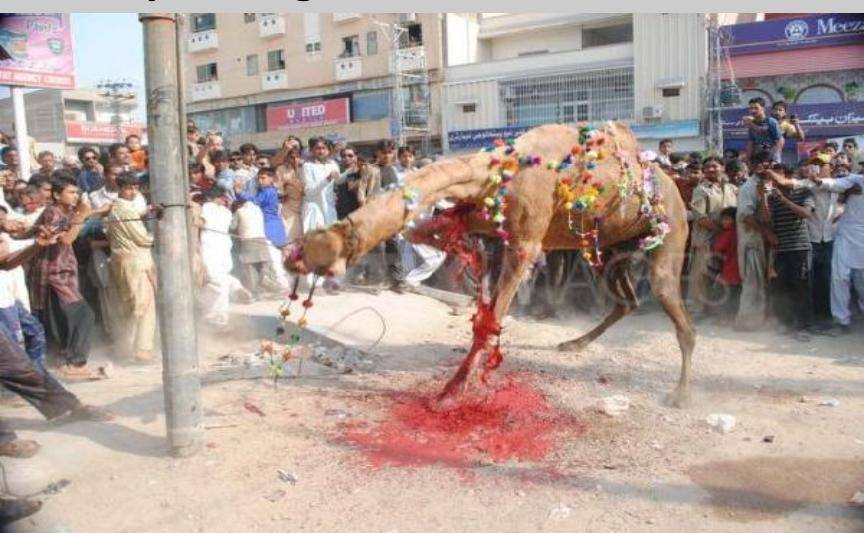
[caption id="attachment_716" align="alignleft" width="300"]camel-halal A camel being killed by 'halal'[/caption]

I am proud to be a European. Our culture has many faults, yet at the same time it has given the world so much. Science and democracy, equality under law and social inclusion simply would not exist without it. And across culture, art, science, engineering and technology, our culture remains a brilliant star, without which light, we would still be in the Dark Ages. I am very proud and lucky to be a part of that.

Despite this, I believed, for many years, that other cultures were equal.

But I was wrong. Culture is not a level playing field. The very qualities that define Western culture represent a system of morality, which allow us to judge other cultures. And we definitely should judge them.

Monday, 8 July 2013

Hot Cross Buns--Cakes for the Goddess


[caption id="attachment_566" align="alignleft" width="294"]hot cross buns are bull buns Hot Cross Buns are eaten every Easter, Pic: Metropolitan Museum of Art, NYC. Used under a Creative Commons Licence[/caption]

Hot cross buns. That's what this article is about. So why do I have a picture of a Roman sculpture of a bull's head here instead of a nice snap of some hot cross buns?


Well, hot cross buns actually originated in Assyria as a part of worship of the Moon Goddess Ishtar. At least that is the earliest record we have of them. The Egyptians continued the tradition of offering cakes to their Moon-Goddess Hathor. They decorated the cakes with bull's horns, as the ox was the preferred sacrifice of the Goddess. The cakes, therefore, were symbolic of the sacrificed bull, whose flesh would be eaten by worshippers.


 Hathor has been identified with Ishtar and Astarte. Astarte is Ashtoreth, who was worshipped by King Solomon, as mentioned in the Old Testament (1 Kings 11, 2), and to whom he erected a temple or shrine in Jerusalem.

Friday, 5 July 2013

Ley-lines: how an English Gent launched the New Age movement

[caption id="attachment_549" align="aligncenter" width="1000"]Ley-libes photo Watkins' Ley-lines--a desire to see pattern. Pic: Rod Fleming[/caption]

Alfred Watkins' Ley-lines


Ley-lines were invented by an Englishman called Alfred Watkins, who had spent much time cycling around the  countryside near his home. In 1925, he wrote a book called “The Old Straight Track”, in which he described a revelation he’d had while looking at a map of Herefordshire four years earlier. He had suddenly seen a network of straight lines that connected points of human activity, such as


 “Mounds, Long-barrows, Cairns, Cursus, Dolmens, Standing stones, mark-stones, Stone circles, Henges, Water-markers (moats, ponds, springs, fords, wells), Castle, Beacon-hills, Churches, Cross-roads, Notches in hills,”


Sunday, 30 June 2013

The Realpolitik of Islamism


[caption id="attachment_447" align="aligncenter" width="655"]Realpolitik Realpolitik: the Battle of Vienna[/caption]

It is now over twenty years since the fall of the Berlin Wall; for many young people, the Cold War, of which it was the most compelling symbol, is no more than a history lesson. In my desk here I have a small piece of concrete, with paint on, which was recovered from that wall and sold as a tourist trinket. It is perhaps the most telling one I have.


Our children do not, as those of my generation did, live in daily fear of being blown to pieces by atomic bombs or dying an agonising death from radiation sickness. They do not walk into their schools to find posters saying “Better Dead Than Red” on the walls, nor do they crowd around flickering television sets alongside their anguished parents, watching as Kennedy drew his line in the ocean, and curled his finger around the trigger of nuclear Armageddon. And for this we should all be very, very thankful indeed. No child should have to live with nightmares like those.